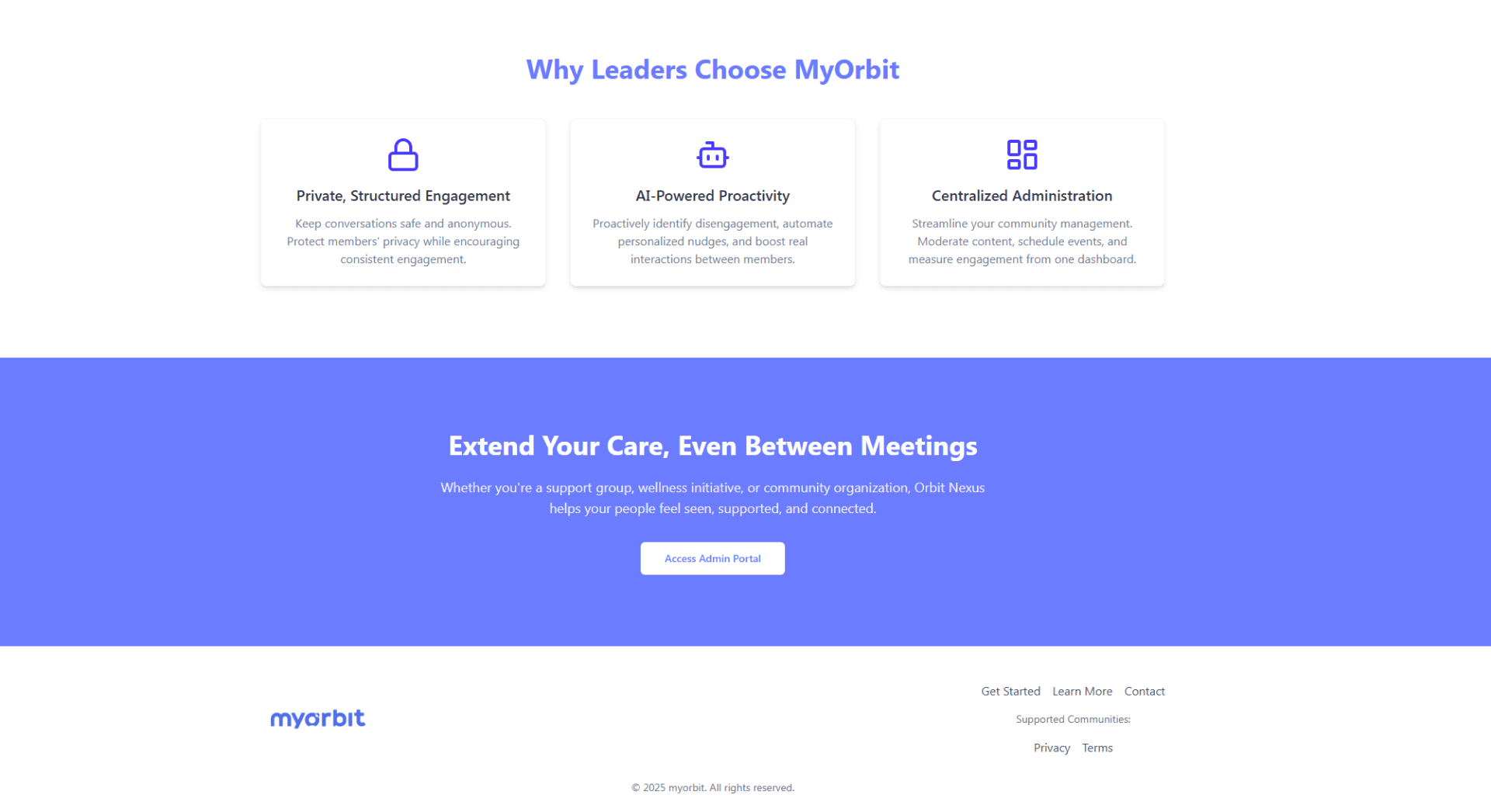
My Orbit was built for organizations whose members cannot afford for the technology to be careless with them: AA chapters, veteran support groups, mental-health peer communities, YMCAs. The product is a community management platform for those operators — a place to onboard members, post announcements, run events, see engagement, and identify members who are quietly disengaging before they fall out of contact entirely.
The architecturally interesting piece is the tenancy model. Most community software is flat — one organization, one community. My Orbit is nested: an organization manages multiple orbits (communities), each with its own member roster, content, and engagement signals, all under a single billing relationship. That two-level structure shows up across the schema (organizations, orbits, orbit_members, posts, announcements) and across the row-level security policies that keep one orbit's data from leaking into another's, even when both belong to the same operator.
The other deliberate piece is the moderation pipeline. AI does the first-pass scan, but every decision passes through human oversight — the policy is built around the populations the product serves. Disengagement detection runs against the same data the dashboard does, surfacing at-risk members to operators so a quiet drop-off becomes a check-in, not a loss. Stripe handles subscriptions end-to-end: checkout, customer portal, webhook ingestion, usage sync. The whole product runs on Supabase (Postgres + RLS + Edge Functions) behind a Vite/React/Tailwind PWA, with a public REST API for organizations that want to integrate.
I founded My Orbit and built it as CEO from 2024 through early 2026. The company wound down in January 2026. The patterns — nested tenancy, AI-moderated peer spaces, disengagement detection as a first-class operator surface — carry forward into the Doers framework and the product work I am doing now.